
VK Cloud Architecture
VK Cloud is a cloud platform that provides network access to computing resources (virtual machines, databases, storage, and other services) on a "pay as you go" basis: you are charged only for the resources you consume.
You rent virtual resources hosted in VK data centers. This eliminates the need to spend money on purchasing and maintaining your own physical servers, and also gives you access to VK Cloud technical support.
VK Cloud offers the following deployment models:
-
Public Cloud — a cloud deployment model in the form of a multi-tenant platform with shared resources (servers, storage, networks). User data is isolated from each other through virtualization, but can physically reside on the same servers. VK Cloud manages the infrastructure, including data center maintenance, hardware procurement, fault tolerance, and network management.
Advantages: scalability, pay-as-you-go billing, access to new technologies.
-
Private Cloud — a deployment model in which resources are allocated separately for each client (usually organizations). Employees of one organization can share its infrastructure, but sharing physical and virtual resources between different organizations is excluded. In a private cloud, it is the client (organization) who controls and maintains the underlying infrastructure.
Advantages: complete data isolation and control, enhanced security. For more information about Private Cloud from VK, see the Private installations portal.
Characteristic | Public Cloud | Private Cloud |
|---|---|---|
Deployment | Automatic | Manual configuration for your specific needs |
Infrastructure maintenance | VK Cloud | You |
Resources | Scalable | Limited |
Cost | Pay as you go | Subscription fee |
Investment | Minimal | High |
Data access | You and VK Cloud | Only you |
Security | Provided by VK Cloud | You configure the required security level yourself based on certified VK Cloud products |
VK Cloud can host virtualization, monitoring, container, and data storage services. The architecture is based on four groups of services:
-
Infrastructure as a Service (IaaS). IaaS services are built on top of OpenStack and in-house developed components. They manage dynamic resource allocation, scaling, and fault tolerance. They are hosted in the same cloud data center as PaaS services. IaaS provides basic components: virtual servers, networking, data storage, and access to dedicated hardware.
-
Platform as a Service (PaaS). These include open source solutions (Kubernetes) and solutions from technology partners. Built-in monitoring of VK Cloud services and individual entities is supported. The PaaS model is built on top of IaaS. It does not require managing the underlying infrastructure, including hardware and operating systems, and allows you to focus entirely on developing and managing applications.
-
Software as a Service (SaaS). Ready-to-use software available by subscription over the internet. It does not require infrastructure or platform management. An example of a SaaS service in VK Cloud is 1C:Ready Workplace. The service provides resources and software for deploying 1C services.
-
Common&Security services ensure secure user operation and support the role-based model when using VK Cloud resources.
The overall diagram of VK Cloud components and services is shown below.
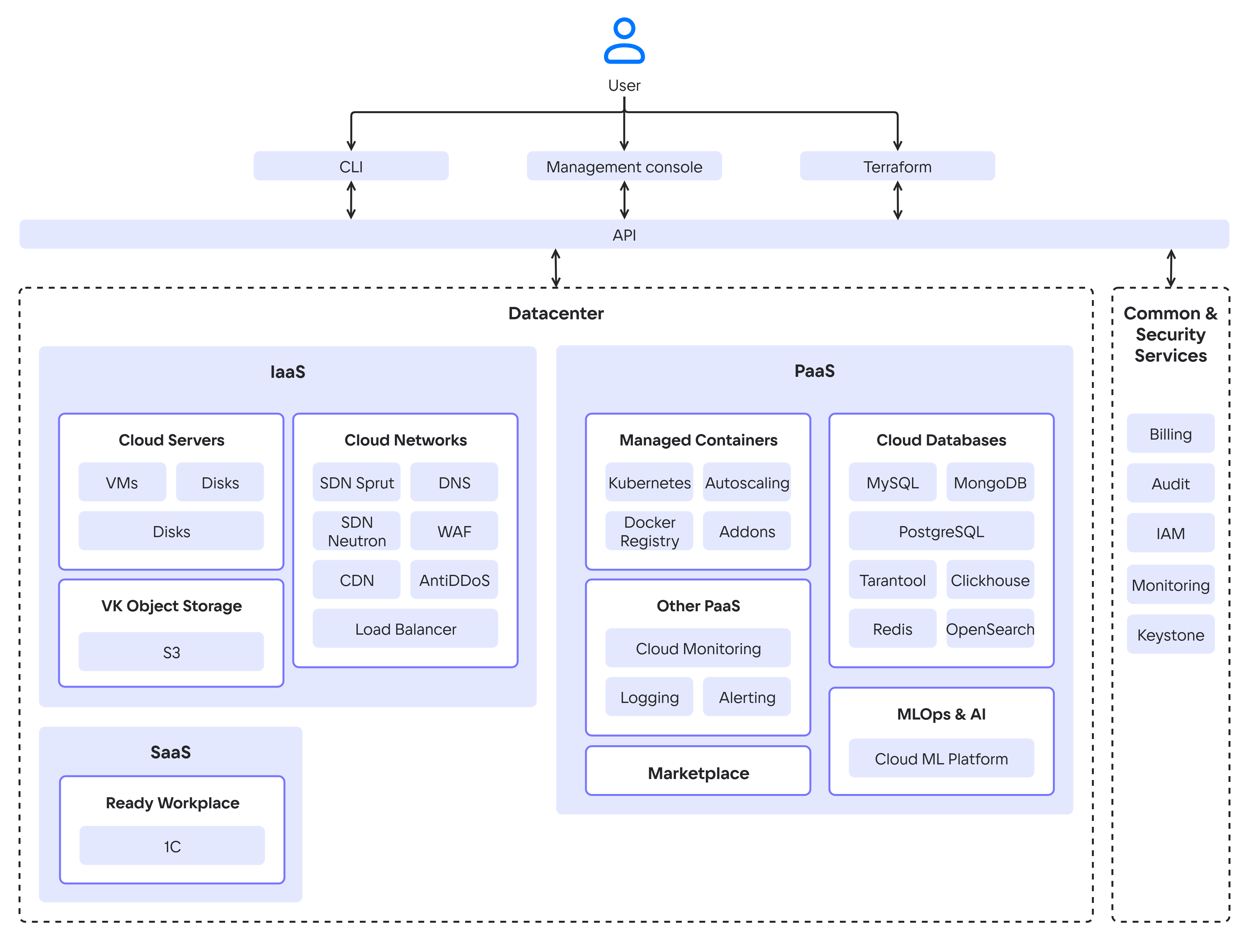
Cloud services are managed using the API. Users interact with the API through one or more tools:
- the VK Cloud management console;
- OpenStack CLI;
- Terraform with a dedicated provider.
VK Cloud provides technical support for its services. Partner solutions (for example, AntiDDoS, WAF) are supported jointly with the partner.
Physical fault tolerance is achieved by hosting VK Cloud in three Tier III data centers in Russia. This placement guarantees data center SLA maintenance above 98% with an overall SLA of 99.95%.
Network fault tolerance is ensured by connecting data centers via routes with a bandwidth of 200 Gbit/s. Each server is connected to backbone providers through two independent channels, via two routers.
Logical fault tolerance is implemented using availability zones, which are grouped into regions.
Each availability zone contains one or more data centers where cloud infrastructure objects are physically located. In VK Cloud, an availability zone corresponds to a separate Tier III data center. VK Cloud provides the following availability zones:
Region | Availability zone |
|---|---|
Moscow |
|
| |
| |
| |
Kazakhstan |
|
|
Each data center is equipped with independent power supply and cooling systems.
Availability zones within one region are connected via a redundant dedicated high-bandwidth, low-latency fiber-optic network for high-speed data transfer between zones.
The security of VK Cloud is ensured by continuous monitoring of VK Cloud services and external audits. The VK Cloud information system is certified in accordance with the requirements of Order No. 21 of the FSTEC of Russia for working with personal data.
The infrastructure of availability zones in all VK Cloud regions is protected in accordance with the Russian Federal Law "On Personal Data" No. 152-FZ.
For more information, see the Platform security section.
VK Cloud supports migration using third-party software or platform tools. Transferring virtual resources is more cost-effective due to the implementation of services based on OSS solutions (Open Source Solutions).